


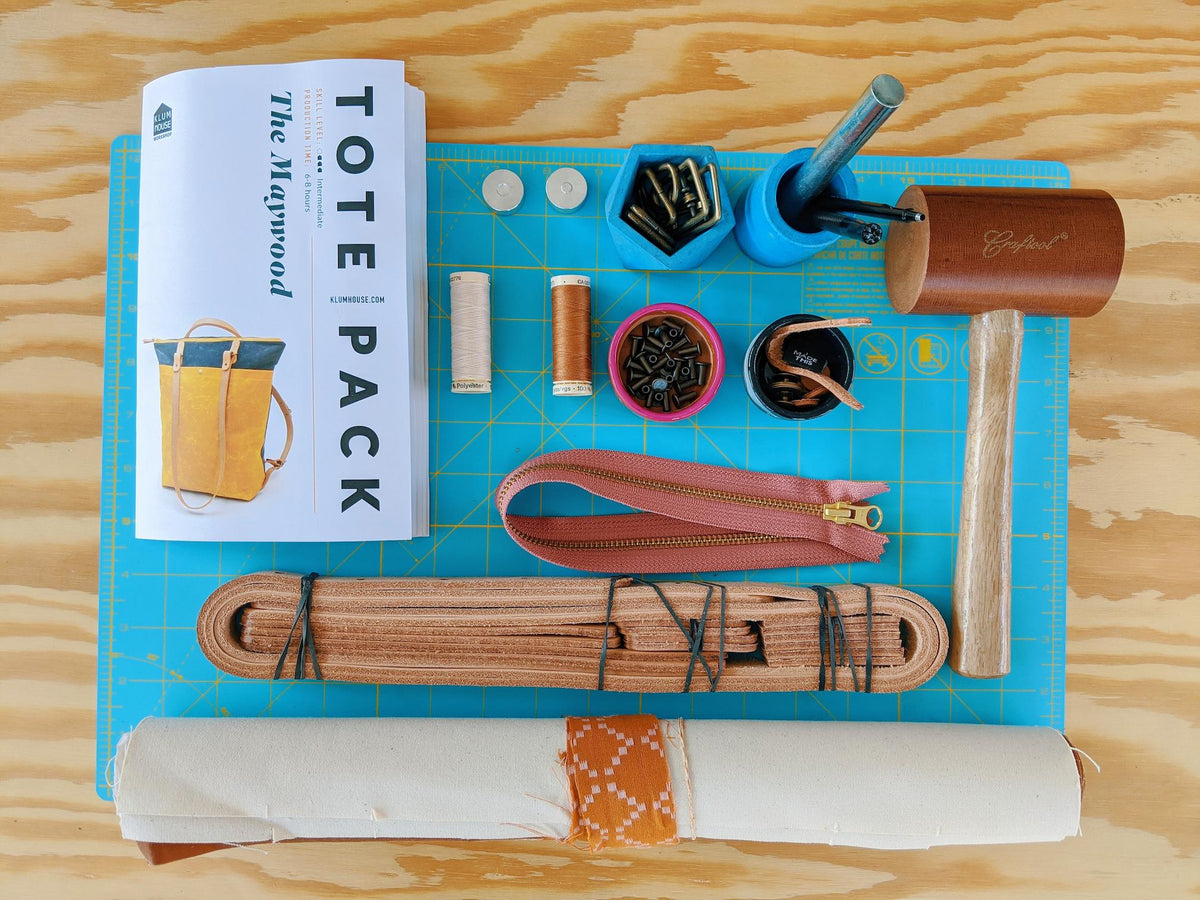
Finished goods don’t just pop into existence. There’s a whole lot of work and specialized knowledge that goes into making them, and that’s as true of a maker kit as it is of the bag you’ll make from it. Here’s the whole chain behind how a Klum House bag maker kit comes into existence.
In The Beginning

Back in the olden days (circa 2016), Klum House began as a small sewing school in the basement of Ellie’s home. Students came to Klum House workshops to learn how to sew—and make bags, of course!
Ellie knew she only had everyone’s attention span for four to six hours at the most, so she’d cut students’ fabric and leather ahead of time, gather up whatever hardware and tools they’d need, and even thread their sewing machines, so they could come in and get straight to the fun part—sewing!


We didn’t know it at the time, but she was prototyping what would become a cornerstone of Klum House’s future offerings: The Maker Kit.
Fast forward a few years, and we’re still cutting and prepping bag making materials, but now we package them up and send them to makers around the world. Some of that work goes out to local makers and manufacturers who can handle a much higher volume than we can. But most of it still happens right here in our studio, where our team cuts your fabric off the bolt, counts every rivet by hand, packs hardware into little baggies, rolls the leather, and loads it all into a maker kit tube before it heads to your doorstep. This is the story of how a maker kit comes to life…
The Evolution of the Maker Kit
For years, we pre-cut every single piece of fabric in every kit. Ellie cutting for her students in the basement, just scaled way up.
Way up. Once a pattern was finalized and we were absolutely certain the measurements were correct, we’d send those measurements to a local fabric cutter, who programmed their industrial fabric cutting machine to these specifications. In the video, you can see a worker at Spooltown, a women-owned sewing factory, cutting spring green waxed canvas for our Slabtown maker kits. Spooltown was even able to pre-punch rivet holes and pre-snip notches into the fabric.
Cut fabric came back to Klum House, where we did a quality-control check, making sure the measurements were accurate and the fabric itself was clean, without any strange markings or uneven wax. In this video, Ellie is sorting and organizing cut pieces of waxed canvas in the studio.
Then we noticed that the waxed canvas actually shrinks after it’s been cut off the bolt.
When waxed canvas is made, the fabric is stretched to allow the wax to fully permeate the fibers. When dry, it’s rolled up onto a bolt and shipped from Scotland to a cutting factory here in Portland. Over the next few days, some of that cut fabric contracts back from its previously stretched state. And the shrinkage isn’t consistent. It depends on the mill run, the color, even which part of the bolt the fabric was cut from. It has been a head scratcher for sure.
We spent YEARS trying to troubleshoot this one. (Turns out not even carefully calibrated industrial cutting machines can achieve perfection. 😅)
So we made the call. The most reliable way to get you pieces at exactly the right size turned out to be you. Every kit now comes with all the fabric you need plus a large-format paper pattern, so you can lay your pieces out and cut them to size on your own table. Open your kit and you’ve got everything you need to start sewing.
1. Fabric Is Cut Off the Bolt
Here at Klum House, we love working with natural, heritage materials. We’re always looking for that perfect combination of durability, function, and beauty, and waxed canvas checks every box. It’s densely woven cotton canvas saturated with wax, and it’s the original waterproof fabric, so it’s got this really heritage quality. That waxy finish helps it stay put at the machine, making it a dream to sew with, and it develops a beautiful, weathered patina over time.
Our waxed canvas arrives on the bolt from a mill in Scotland. When your order comes in, we roll it out and cut you enough fabric to make your bag, and that goes in the tube with your large-format paper pattern.

2. Leather Is Cut With a Hydraulic Press

To cut all of the leather pieces needed to make our bags—tote straps, handles, backpack straps, reinforcement tabs, leather washers, zipper pulls—we first create leather dies, which are like stencils made of steel. These dies allow a large quantity of pieces to be cut very precisely, with rounded or straight ends and all of the correct-sized holes exactly where they need to be.
We then work with a local saddle maker named LP, who uses these dies in conjunction with his hydraulic press (also called a “clicker press”) to cut our leather pieces. We love that we are able to support local small-batch manufacturing here in Portland this way.
We use as much of the hide as possible. To minimize waste, we use offcuts to make smaller pieces, like leather washers and zipper pulls, or we sell them in our online shop as leather scrap grab bags!
Leather


3. Leather Is Organized and Bundled In-House

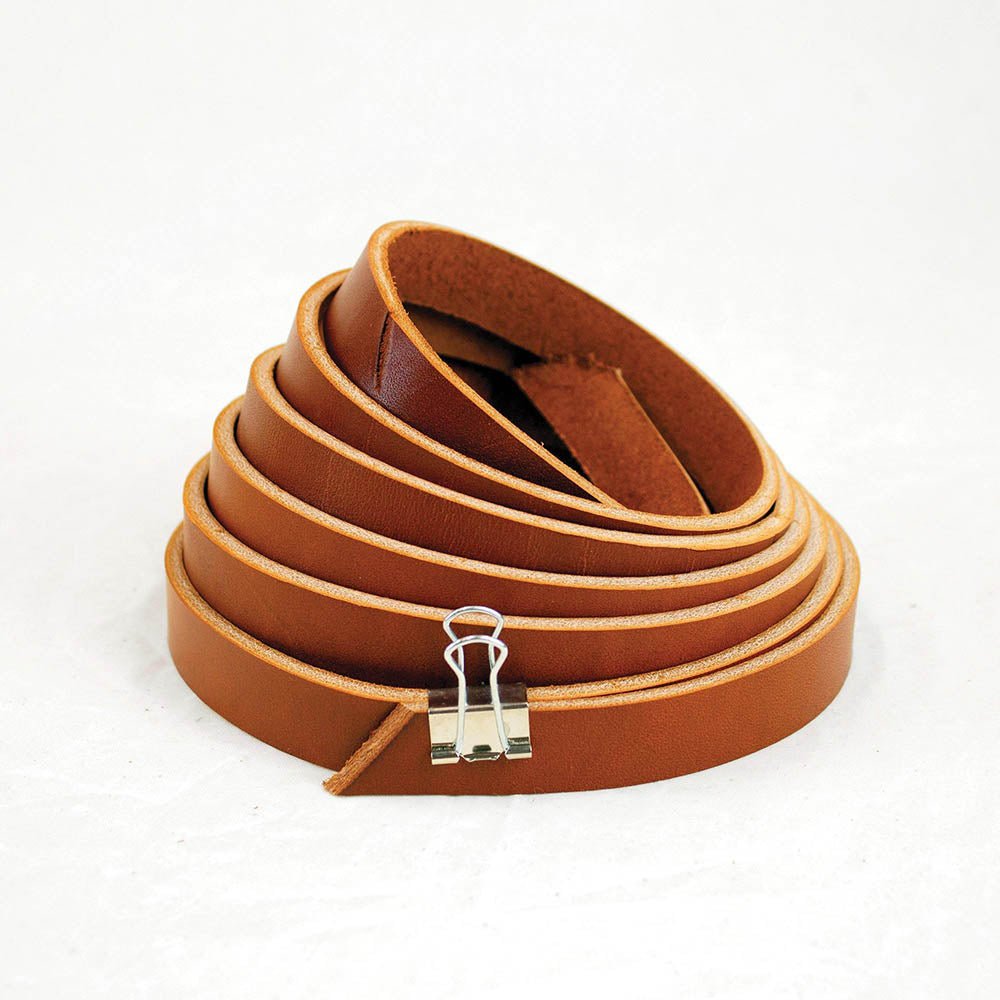
After LP cuts the leather, it is delivered to Klum House where it goes through a quality control check. Because leather is an organic material, it’s normal for it to have some slight inconsistencies in color and texture. We are big believers in embracing those imperfections (and minimizing waste!). That said, if there are any straps that are particularly marked or discolored, we set those aside and use them for Seconds Kits!
In this video, you can see Heidi bundling up all of the chestnut brown leather pieces needed to make the Slabtown Backpack. (Bundling the leather this way makes it easier to fit in the tube.)
4. Hardware Is Counted by Hand and Put Into Baggies
Every one of our bags requires a different set of hardware. Here you can see Heidi gathering up all of the hardware necessary to make one Slabtown Backpack and putting it into a little bag. She carefully counts out the rivets (making sure to include a few extra in case of mistakes!), Line 24 snaps, buckles, zippers, and leather zipper pulls and puts them all into one neat little package.
Because our hardware comes in three different colors (brass, antique brass, and black) and our leather comes in two (black and chestnut), there are six different combinations of leather and hardware (!!!) that get packed together, stored, and labeled, so we can easily grab the correct one when orders come through.

5. Tubes Are Stickered by Hand In-House

Every one of our maker kit tubes gets stickered right here in the studio.
Shout out to our friends at StickerGiant for being speedy and reliable and always making our packaging look good 👌 (Just a few hundred more stickers to go! 😅 Make Time Playlists really coming in clutch these days.)
6. Kit Orders Are Assembled and Packed
When orders come in, we cut your fabric, pull the correct leather and hardware colors, and pack it all together into a tube! Essentially, a finished maker kit is a bundle of materials that is itself made up of several smaller bundles of materials. All of the previous sorting, packing, and organizing comes in really handy at this point. It makes it much easier to pull exactly what’s needed on the fly.


7. Kits Are Mailed Out and Delivered to YOU!

Finally, kits are packed into USPS priority mailing boxes, picked up by our pal the postman, and begin their journey to your doorstep. As you can see, before you begin making, your materials have already undergone quite the production process! It takes a lot of labor and the help of several different local manufacturers to get all of the ingredients to a state where they are ready for you to take over and turn them into a beautiful finished bag.
An important part of what we do here at Klum House is help pull back the curtain and reveal just how much labor and skill goes into creating a finished, handcrafted good. Behind every finished product is a long chain of production, often involving many factories and pairs of hands. It’s humbling and empowering to understand the full creation story of the objects we use in our everyday lives. And so cool to think about how your own role as a bag maker is intricately tied to a much larger, collaborative process of creation!
Bag Maker Kits


About the Author
