


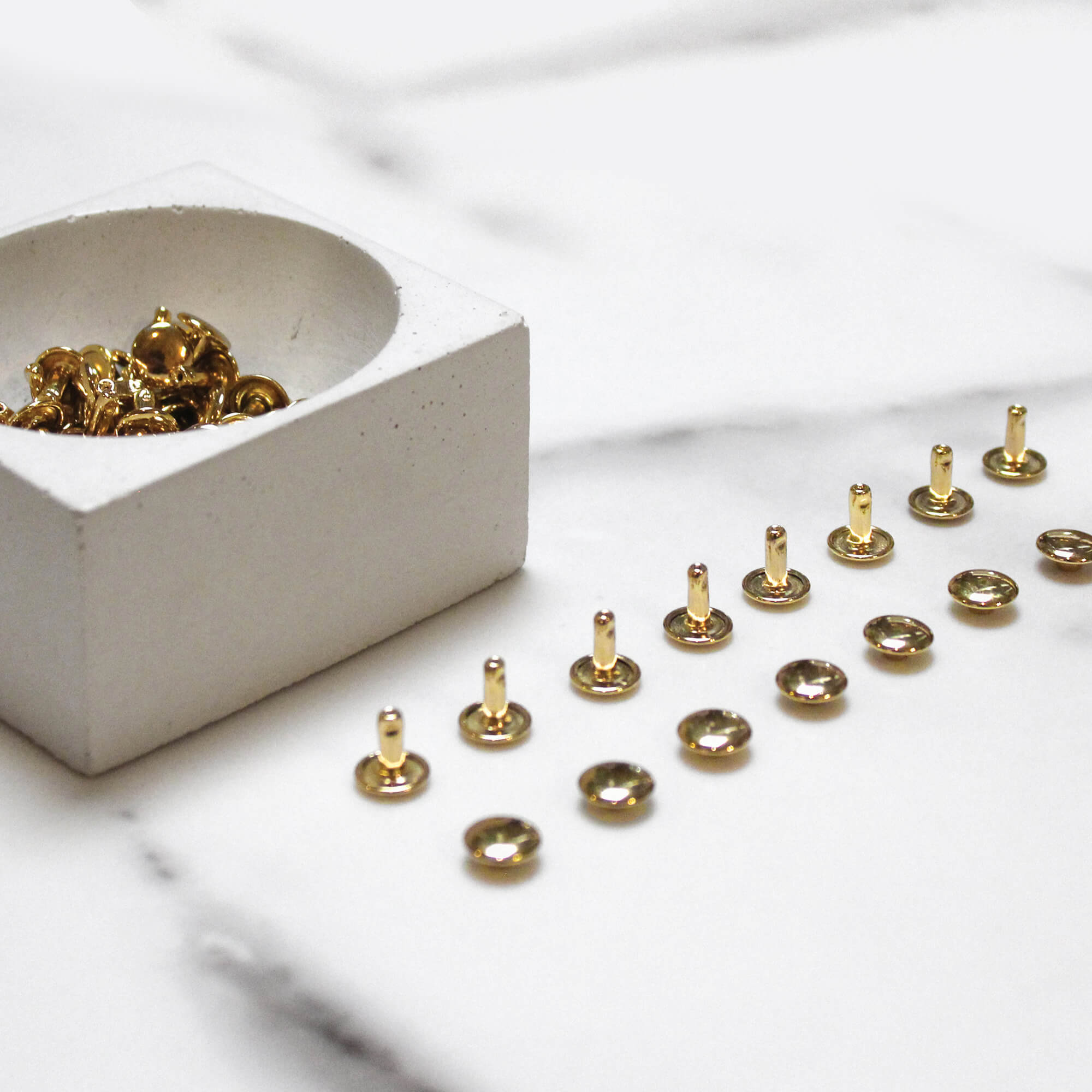
The fastest way to remove a rivet is with a rivet removal tool: match the hole to your rivet's diameter, center the strike post, and hit it with a mallet. We show you the step-by-step process in a fuss-free way.
No tool? Pliers and a pair of angle cutters will get it done. It just takes longer, and it takes more care.
What you'll need
With the removal tool: the tool itself, a non-rubber mallet, a punching board, and pliers for any rivet that doesn't drop all the way out. Both are available on the tool's product page. The punching board matters — put it under the tool every time so you don't bend the pin punch.
Without it: two pairs of pliers (they don't have to be different sizes) and angle cutters. A larger pair from the hardware store works for double-cap rivets. Small jewelry angle cutters are easier to get into a tubular rivet.
Double-Cap Rivets
A double-cap has a finished cap on both faces, so they look the same. But it matters which one you work from. Set the piece down with the inside face up and work from the back of the bag — that way anything that gets chewed up is the leather washer, not your strap.
With a rivet removal tool
- Match the hole. Look through and find the one that most closely matches the diameter of your rivet head. Hold it in place over your punching board.
- Center the strike post on the cap, working from the inside face.
- Strike it with the mallet. All the tool does is cut a hole through the center of the stem to break the bond, so hit it until the strike post breaks through the rivet cap.
- The rivet falls off.
Without the tool
- Work from the inside. If you end up having to pull hard on leather to free the rivet, you want to be pulling on the washer. A washer is a lot easier to replace than a strap.
- Tug it apart. One pair of pliers on each piece of leather, and pull. You have to tug pretty hard sometimes. Sometimes they separate a little, sometimes they barely budge. You'll see what you get to work with.
- Get under the cap. Bend the leather back and work the angle cutters in, pulling the rivet toward whichever side you're coming in from. Keep your hand out of the line of fire — these are sharp and you're using real force. (Nobody's removing a rivet on a good day. Take five if you need to; sharp tools and frustration don't mix.)
- Cut the post. Once you can feel you're on it, turn the cap face down and look away before you cut. It likes to fly off.
- Pull the other half out.
Tubular Rivets
A tubular rivet has a smooth cap on one side and splayed spokes on the other. The spokes are the peened side, and that's always the inside — the wrong side of your work. So you're working from the inside here too, both with the tool and without it.
With a rivet removal tool
- Match the hole. Find the one that most closely matches the diameter of the rivet head, and hold it in place over your punching board.
- Center the strike post in the middle of the spokes.
- Strike it with the mallet. It pushes the whole rivet through to the other side, reversing the "splayed spokes" back out. Keep striking it until all the spokes have been pushed back through the way they originally came from.
- Pull it free. If it doesn't quite clear, grab it with pliers.
Without the tool
- Tug it apart. Pliers on each piece of leather, pull, and open up as much room in the tube as you can.
- Lift and cut each spoke. Take the jewelry angle cutters, lift one spoke at a time, and cut it off. Watch where the force is going and keep your hand clear.
- Work the leather off. Once the spokes are gone, come in with the pliers — pulling on the washer side, since that's the part you'll be replacing anyway.
- Pull the rivet out of your work, then out of the second piece.
- To keep that second piece pristine, cut the stem off instead of pulling it through. Point it at the table and look away, or wear safety glasses.
The Rivet Removal Tool
Remove rivets without fuss! This rivet removal tool is a total game changer. It makes removing metal rivets (both double-cap and tubular) so quick and easy. It comes with a strike post and a base with die-cuts for different sized rivets.

"Game changer Rivet Removal Tool! This tool is a game changer for my handbag production. It was such a struggle to remove rivets without it and I often damaged the fabric or leather. Now I can do it with ease. Thank you for fast shipping and always great service."
— Cheri P.
Will the new rivet still hold?
Yes. The rivet isn't gripping the hole in the fabric — it's holding the fabric sandwiched between two pieces of leather. So even if that hole opens up while you're getting the old rivet out, the new rivet still has everything it needs to hold.
If the leather washer gets chewed up a little during removal, it's quick and inexpensive to swap out!
Need to set your replacement rivet? ▶️ Bag Making Rivets 101 covers Ellie's best tips and tricks for setting it correctly.
Rivets

About the Author
