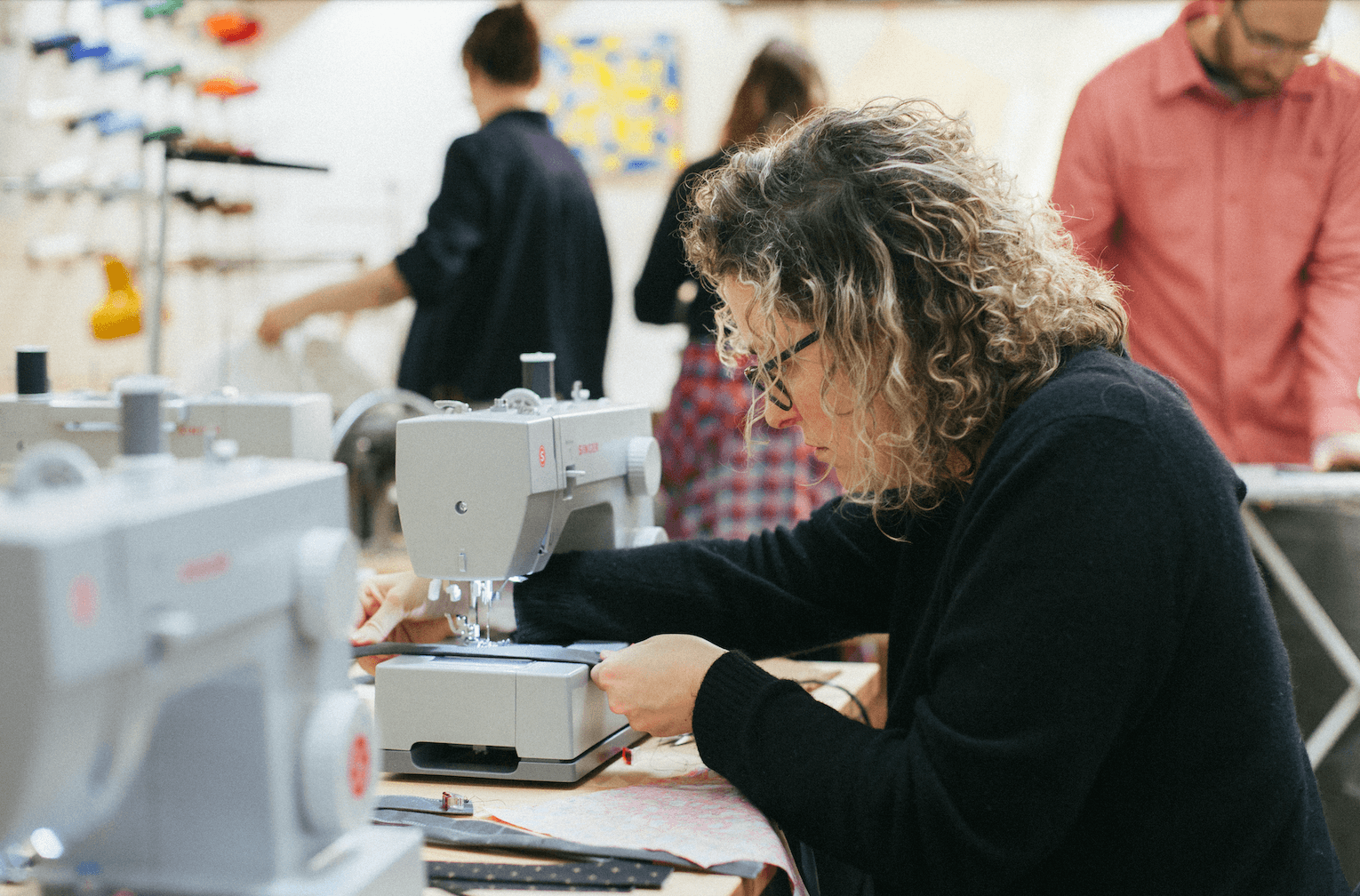
You might take one look at a heavy-duty bag and think “my sewing machine could never do that.” But it can! You can.
Can my sewing machine sew that? It is the question Ellie gets asked most often, and the good news is that the machine you already own can probably do it. “Heavy duty” on a home machine means a stronger motor and more metal parts, and Ellie has made every Klum House bag pattern on a machine that isn’t heavy duty at all.
The answer comes down to a few things: which machine, which model, and how it has been used and taken care of over its life. By the end of this you’ll be able to answer it for your own machine, and know what to look for if you’re buying a new one.
At Klum House we’re strong believers that you don’t need a fancy sewing machine or expensive tools to make really amazing things. Ellie tests machines against our patterns as she develops them, precisely so that the patterns never require an expensive, fancy machine. She wants sewing to be accessible.
So the machines further down are the mechanical, lower-budget end of the range. There are plenty of other great machines out there, and plenty of them cost a great deal more. These are the ones we recommend, the heavy-duty machines that are fantastic without breaking the bank.
In this workshop replay, Klum House founder Ellie Lum talks all about home sewing machines for bag making. Read the full post below.
What “Heavy Duty” Actually Means
A quick history lesson. When sewing machines were first invented they were all industrial machines, which meant stronger motors and all metal parts. As machines progressed they got more portable, the kind you can stow in a closet and pull out for a project, and the gears ended up encased in plastic.
But the mechanism never changed. Industrial, heavy duty, or a Hello Kitty machine, they are all doing the same thing: a lock stitch, a top thread and a bobbin thread looping around each other over and over.
So when a machine says HD on the side, what you’re being told is that the motor is strong enough to punch through thicker woven fabric, and that there’s more metal in it. That’s it. It usually has a metal faceplate and a metal base, and it’s heavier to pick up.
What makes it work well is the same thing that makes any machine work well: good tension and good timing. ▶️ How to Sew Thick Fabric on a Home Sewing Machine goes deep on both, and on what throws them off.
Can My Machine Handle Sewing Bags?
So, can your sewing machine handle it? It comes down to two questions:
- Can this machine sew the projects you actually want to sew?
- Can you accessorize it with the attachments you want?
The best way to answer the first one is to try sewing that thing on your machine.
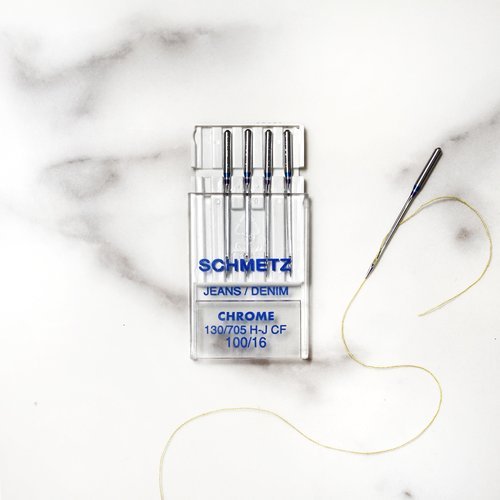
Get some canvas or waxed canvas, fold it to the thickness your project actually calls for, and run it through. Use all-purpose thread, which is what Klum House uses for everything, and a fresh denim needle (or a nonstick needle if you’re sewing waxed canvas). Watch what the stitch does.
For context on how forgiving this is: across years of in-person classes, exactly one machine couldn’t do it, and it was a Hello Kitty machine. People have made Klum House bags on machines from the sixties, seventies, eighties and nineties, low end and high end.
If the stitch is skipping or the thread is clumping underneath, that’s a tension and timing problem, not a verdict on your machine. ▶️ How to Sew Thick Fabric on a Home Sewing Machine walks through exactly what’s happening and how to fix it.
If you want an in-depth tutorial on how to troubleshoot skipped stitches, and a deeper understanding of how your sewing machine works so that you can unlock your creative potential, check out our Sewing Machine 101 class.
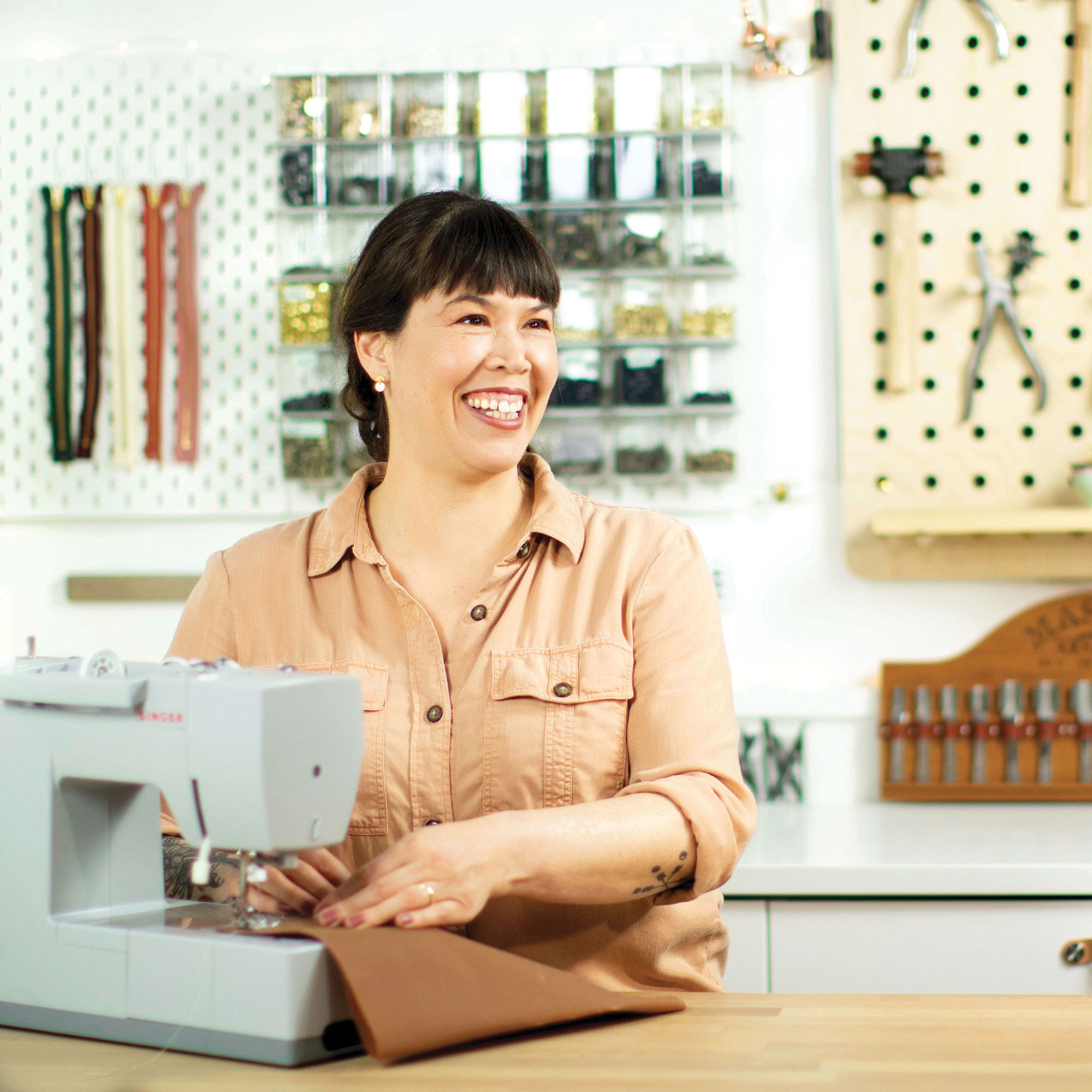
It starts with tension and timing, because everything else you will ever do on that machine rests on them. And if your machine has been in a closet gathering dust, this is the place to start.
Machines We Recommend

Two main HD machine families, one Singer and one Janome. The main differences come down to price point and, on the Singers, how many stitches each model has.
| Machine | Heavy duty | Price point |
|---|---|---|
| Singer HD 4423 | Yes | Entry. 23 stitches, and Ellie’s go-to |
| Singer HD 4432 | Yes | Entry. 32 stitches |
| Janome HD1000 | Yes | About twice the Singer |
| Janome HD3000 | Yes | Mid-range |
| Janome HD5000 | Yes | Top of the range |
| Janome 2212 | No | Entry, and a great learning machine |
| Brother Project Runway | No | Entry |
The Singer Heavy Duty series. Ellie’s own go-to is the 4423, and it’s what Klum House taught on for years of in-person classes. The number tells you the stitch count: the 4423 has 23, the 4432 has 32. Both do the triple straight stitch, which is a really nice feature to have, and both give you needle position center, left and right, plus a presser foot pressure dial that earns its keep on thick fabric.
The Janome HD series. HD1000, HD3000 and HD5000, at rising price points. The HD3000 and HD5000 both have 18 stitches, so between those two you are mostly choosing on price. Ellie sews on an HD1000 (she got hers long before the 3000 and 5000 existed, and it still works great). More metal parts than the Singer, roughly twice the price, and built to last longer. Fabric clearance is about the same in practice. One thing specific to the older HD1000: it has no right needle position, where the Singer does.
Here are two non-heavy-duty machines that also work great. Ellie has made every bag pattern Klum House sells on the Project Runway Brother, and she taught on the Janome 2212 for years at Workshop SF DIY school. They may need some extra help getting through thick layers, but you can set them up for success by using a sharp needle and a walking foot, going slow, and even walking the hand wheel.
If your machine isn’t on this list, it doesn’t mean it’s not great. It’s just a short list of mechanical machines that Ellie knows to be tried and true.
Mechanical or Computerized
Ellie teaches on mechanical machines, and recommends them for learning.
Not because computerized machines are bad. They’re fun to sew on, and at conferences she’s taught on some very fancy ones. But a mechanical machine helps you learn how to use the machine, instead of assuming it’s going to do everything for you.
The difference shows up in control. Sometimes you want your back stitch to be very controlled. You want to know exactly where that needle is going, and you might change the stitch length halfway. You get far more of that on a mechanical machine than on a highly computerized one.
There’s also maintenance. Mechanical machines are easier to look after yourself, which matters if you’d rather oil your own machine than book it in every time.
How to tell them apart: if there’s an LCD screen on it, it’s probably computerized.
The Features to Look For
Needle position, left and right. This is the first thing Ellie looks for. Being able to move the needle to center, left and right gives you real versatility for edge stitching, because the bulk of your work always sits to the left of the machine. Sometimes you want to topstitch to the right of center and sometimes to the left, and a machine that only does center makes you fight for it.
A free arm. That’s the ability to remove the flat part of the bed so you can sew in a cylinder. Industrial machines often don’t have one, because in a factory each machine does one specialized job. A home machine is built for one maker to take one project start to finish, so it needs to be versatile. A free arm gets you into tight corners, bottoms and curves without sewing another part of the bag into the seam. It’s rare to find a home machine without one, but check.
Presser foot pressure. Some machines let you dial the pressure on the presser foot up or down. It’s a genuinely useful feature for heavy-duty sewing, because more pressure helps the layers feed evenly through thick fabric.
What you don’t need: a lot of stitches. As Ellie puts it, a lot of times sewing machines are trying to upsell you, because they want to sell you twenty more stitches. Well, she only needs three, maybe four stitches to make bags. Unless you’re heading for embroidery, decorative stitches are not what your money should be buying.
Older Machines, and Quilting Machines
Plenty of us are sewing on hand-me-down machines, and those work great too. They are often built a lot more heavy duty than anything modern.
Vintage machines are often heavy duty by default. Older machines tend to have really good motors, frequently more powerful than a newer machine at the same price point, because there’s more metal in them.
The caveat is care. A machine that’s been in storage for a decade needs servicing before you judge it. Like a car, it has to be oiled and regularly maintained, and metal moving against metal needs lubrication.
Quilting machines are also great for bag making, and there’s more crossover than people expect: lots of layers, larger pieces of work, and bed extensions that give you more surface to maneuver a bag on.
Sewing Machine Attachments
This is the one that trips people up. Presser feet are not universal.
Before you buy a walking foot or any other attachment, check the product description says it works with your brand and your model. Does your machine take a low shank or a high shank? If you’re on a Bernina, you can only buy Bernina feet. Your manual will tell you which you have.
Two attachments earn their place for bag making, and both exist to stop your machine skipping stitches on thick fabric.
A walking foot, also called an even feed foot or a quilting foot, has its own set of feed dogs. It pulls the top layer through at the same speed your machine’s feed dogs pull the bottom layer, so the layers stay together instead of shifting.
A thick seam jumper, also called a hump jumper or a jean-a-ma-jig, is a little block you slide under the back of the presser foot when you’re climbing onto a thick seam. It keeps the foot level, which is what stops your machine losing tension at exactly the wrong moment.
▶️ How to Sew Thick Fabric on a Home Sewing Machine shows both of them in use.

TL;DR
- “Heavy duty” means a stronger motor and more metal parts. The mechanism is identical to any other home machine.
- Mechanical over computerized for learning, because you keep control of the stitch and can maintain it yourself. An LCD screen means computerized.
- Look for needle position left and right, a free arm, and presser foot pressure. Ignore the extra decorative stitches.
- What matters is whether the machine sews the projects you want to sew, and takes the attachments you want.
- The Singer Heavy Duty and Janome HD series are both solid. A non-HD machine is fine too, if you set it up for success.
- Test before you buy anything: sew your actual fabric at your actual thickness with a fresh needle.
- Check shank type before buying any presser foot.
Learn More
You don’t need an expensive machine to make professional-quality bags. ▶️ How to Sew Thick Fabric on a Home Sewing Machine is the technique half of this, and ▶️ Essential Guide to Waxed Canvas, ▶️ Leather for Bag Straps 101 and ▶️ Bag Making Rivets 101 cover the materials.
“Excellent instruction on what you can do with a home machine and the differences between industrial and home. Home machines have much more versatility than I understood.” — @Stratocruizer51
TAKE SEWING MACHINE 101
About the Author